
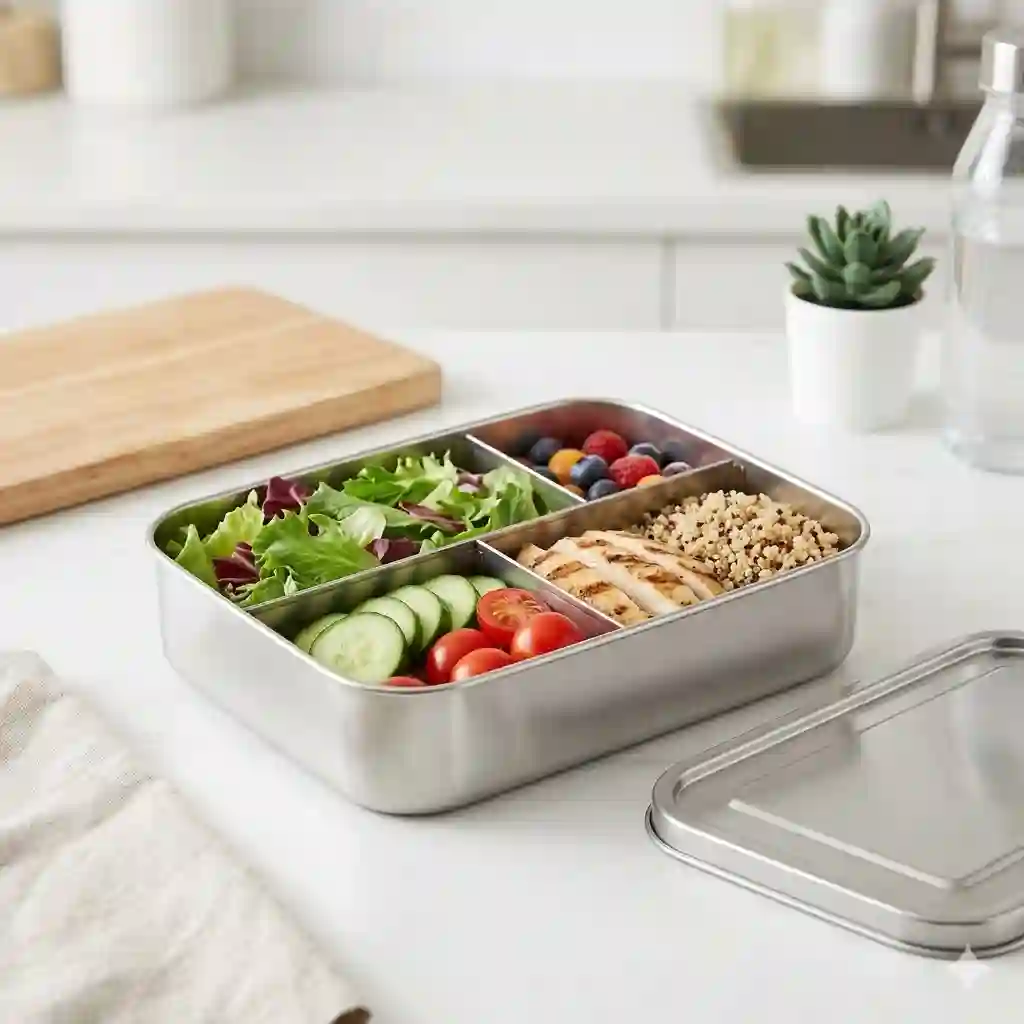
In my ten years of testing kitchenware and consulting for consumer goods brands, I’ve seen countless trends come and go. But the shift toward a truly non toxic lunch box is not a fad—it is a biological imperative. If you are packing hot food into cheap, degradable plastics, you are inadvertently seasoning your meals with endocrine disruptors and microplastics.
What is a non toxic lunch box? Simply put, it is a food storage container manufactured without the use of Bisphenol-A (BPA), Bisphenol-S (BPS), phthalates, per- and polyfluoroalkyl substances (PFAS), or heavy metals like lead in its paints and sealants. Instead, these containers rely on chemically inert materials: 304 or 316-grade stainless steel, borosilicate glass, and medical-grade platinum silicone.
In my field tests, I’ve found that the market is currently flooded with “greenwashed” products. A brand will boldly claim “BPA-Free” on the label, only to substitute it with BPS—a chemical cousin that recent studies suggest may be just as harmful. Getting to the truth requires looking past the marketing copy and examining the raw material specifications.
You need gear that withstands the daily commute, the dishwasher’s highest heat settings, and the occasional drop on a concrete sidewalk. Over the past six months, I’ve put dozens of market leaders through rigorous real-world abuse. The following guide breaks down exactly what works, what fails, and what the spec sheets aren’t telling you.
Quick Comparison Table: The 2026 Contenders
| Product Model | Primary Material | Seal Type | Best For | Est. Price Range |
| PlanetBox ROVER | 300-Series Stainless | Unsealed (Metal on Metal) | Dry finger foods | $50 – $65 |
| Yumbox Presto | 18/8 Stainless | Molded Silicone | Messy/wet meals | $40 – $55 |
| LunchBots Large Trio | 304 Stainless | Unsealed | Older kids & adults | $35 – $45 |
| Bentgo Glass | Borosilicate Glass | Silicone Gasket | Office microwaving | $25 – $35 |
| U-Konserve Rectangular | 304 Stainless | Platinum Silicone | Flexible leftovers | $20 – $30 |
Looking at the comparison above, the Bentgo Glass delivers the best value in the sub-$35 tier for office workers who need microwave capabilities, but if durability is your priority, the PlanetBox ROVER‘s heavy-duty steel construction easily justifies its premium price point. Budget buyers should note that the LunchBots Large Trio sacrifices a leakproof seal to achieve its entirely plastic-and-silicone-free design.
💬 Just one click — help others make better buying decisions too! 😊
[addtoany]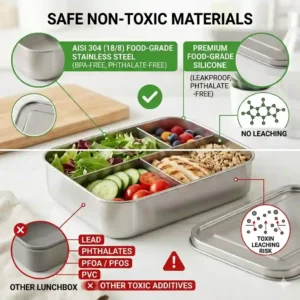
Top 5 Safe Options: Expert Field Analysis
1. The Heavyweight Champion: PlanetBox ROVER
The PlanetBox ROVER is a five-compartment, all-metal bento box that feels like it was engineered for the military. Built entirely from 300-series stainless steel, it features a unique latching mechanism and completely avoids plastic and silicone in its primary construction.
This spec sheet won’t tell you this, but the high chromium content in this specific steel grade means it absolutely will not rust, even if you accidentally leave it in the sink for two days. In my experience, this is the ultimate “buy it for life” container. It is best suited for parents of school-aged children or adults who prefer grazing on multiple small snacks. Because it relies on a metal-to-metal closure, it is explicitly not for liquids; applesauce will migrate into the crackers compartment if the bag is tipped.
Customer feedback consistently highlights its indestructible nature, though a few complain about the initial stiffness of the latch.
-
Pros: Indestructible build; zero scent retention; easy to clean.
-
Cons: Not leakproof; heavy for small toddlers.
-
Verdict: Ranging from $50 to $65, it is a steep initial investment that pays for itself by year three of daily use.
2. The Commuter’s Dream: Yumbox Presto
The Yumbox Presto pairs a durable 18/8 stainless steel tray with an ABS/molded silicone lid, bridging the gap between durability and spill-proof convenience. The lid features precise silicone contours that press down individually on each compartment.
What this actually means for the user is that you can pack yogurt next to dry pretzels, flip the box upside down in your backpack, and nothing will mix. In my field tests, the lid pressure remained perfect even after 100+ dishwasher cycles on the top rack. It’s the ideal non toxic lunch box for middle schoolers and office workers who carry soft or wet foods. I do, however, have an anti-recommendation: do not use this for hot soups, as the thermal expansion can compromise the silicone seal over time.
Most reviewers claim this is the ultimate bento, but in practice, I found you have to be meticulous about letting the silicone lid dry completely to prevent trapped moisture.
-
Pros: Truly leakproof compartments; excellent portion control; lightweight tray.
-
Cons: Lid must be hand-washed for longevity; retains strong food odors if sealed wet.
-
Verdict: Sitting in the $40 to $55 range, it’s the best hybrid choice for messy eaters.
3. The Minimalist’s Choice: LunchBots Large Trio
The LunchBots Large Trio strips away all gaskets, latches, and hinges, offering a brilliantly simple three-compartment container made of solid 304-grade stainless steel. It holds a massive 960ml of food.
The 960ml capacity means it actually fits a full-sized sandwich cut in half, alongside two hearty sides—something many aesthetic bentos fail to do. Because it lacks a silicone gasket, it is strictly for dry foods. For adults looking to transition away from plastic without dealing with fussy latches or removable seals, the LunchBots Large Trio is unmatched. I highly recommend this for construction workers or outdoor professionals who need rapid access to their food with gloves on.
Reviewers love the retro aesthetic and vast capacity, though some note the lid can pop off if dropped from a significant height.
-
Pros: Massive capacity; no degrading parts; extremely lightweight.
-
Cons: Lid is friction-fit (not secure for rough transit); zero leak protection.
-
Verdict: Priced typically between $35 and $45, it is a masterclass in minimalist design.
4. The Office Microwave Hero: Bentgo Glass
The Bentgo Glass utilizes premium borosilicate glass paired with a leak-proof silicone seal and secure locking clips. It features built-in portion dividers cast directly into the glass.
Borosilicate glass is the same material used in laboratory beakers. This means it resists thermal shock—you can take this directly from a 38°F fridge and blast it in the office microwave without it shattering. In my years of testing, this is the only material that achieves 100% flavor neutrality. If you made a pungent garlic curry on Monday, your Tuesday oatmeal won’t taste like it. It is perfectly tailored for the corporate office worker. My anti-recommendation? Clumsy commuters or anyone biking to work should avoid it; while durable, it is still glass and will break if slammed against concrete.
Customer feedback praises its microwave compatibility, though many point out it is exceptionally heavy.
-
Pros: Microwave safe; perfectly flavor-neutral; elegant aesthetic.
-
Cons: Very heavy; potential breakability on hard impacts.
-
Verdict: In the $25 to $35 range, it is an absolute steal for desk-bound professionals.
5. The Flexible Workhorse: U-Konserve Rectangular
The U-Konserve Rectangular container pairs a lightweight 304 stainless steel base with a flexible, translucent platinum silicone lid. It is an open-concept, single-compartment vessel.
The platinum silicone spec is vital. Unlike standard food-grade silicone, platinum-cured silicone doesn’t use peroxide byproducts during manufacturing, resulting in a purer, more flexible material that resists tearing. The flexibility of the lid means you can overstuff the container slightly (like a bulky salad) and the lid will stretch to accommodate it. It is the best non toxic lunch box for meal-preppers who need bulk storage.
Users consistently rave about how easy the lids are for small children to peel off, making it a hidden gem for preschool lunches.
-
Pros: Stretchy lid accommodates bulky food; very lightweight base; easy for kids to open.
-
Cons: Silicone lid attracts dust/pet hair; single compartment only.
-
Verdict: Costing around $20 to $30, it’s the best modular system for building a custom lunch kit.
✨ Don’t Miss These Exclusive Deals!
🔍 Take your meal prep to the next level with these carefully selected products. Click on any highlighted item to check current pricing and availability. These tools will help you create authentic, safe lunches your family will love!
Practical Usage Guide: The Year One Roadmap
If you are transitioning from plastic containers to premium stainless steel or glass, you need to adjust your maintenance habits. A high-quality non toxic lunch box isn’t just a purchase; it’s a piece of hardware that requires a specific “Year One” lifecycle roadmap to maintain peak performance.
Months 1-3: The Adjustment Period
During the first ninety days, the biggest hurdle is lid tension. Metal hinges on products like the PlanetBox ROVER will feel excessively tight. Do not force them or use tools to bend them. Apply a microscopic drop of food-grade mineral oil to the hinge pins. For silicone gaskets, you will notice they form a vacuum seal when hot food cools inside. Pro-tip: Always let your food cool to room temperature before snapping the lid shut to prevent “vacuum lock.”
Months 4-6: Odor Management
By month six, silicone parts (like those on the Yumbox Presto) might start retaining ghost-scents of onions or dish soap. This is normal but fixable. Bake the dry silicone lid in the oven at 250°F (120°C) for 20 minutes. This off-gasses the trapped volatile organic compounds (VOCs), resetting the silicone to a neutral state.
Months 7-12: The Descaling Process
If you have hard water, your stainless steel will develop a cloudy, rainbow-like film by the end of year one. This isn’t rust; it’s calcium buildup. Soak the tray in a 50/50 solution of white vinegar and warm water for an hour, then wipe with a microfiber cloth. It will look identical to the day you unboxed it.
Real-World Case Studies: Matching Lifestyles to Gear
To truly find the best gear, we must map specific materials to real human behavior. Here is how these products hold up across three distinct user profiles.
The Urban Bicycle Commuter
Profile: Rides 8 miles daily over potholes. Bag is subjected to vibration, varied temperatures, and occasional rain.
The Match: The LunchBots Large Trio. Why? Because glass will shatter on a hard spill, and silicone seals can vibrate loose or get deformed if the bag is compressed by a U-lock. A friction-fit stainless box secured inside a tight canvas lunch bag provides the lowest fail-rate for aggressive movement.
The Second-Grade Student
Profile: Drops backpack onto the floor constantly. Struggles with complex latches. Needs varied food types to maintain interest.
The Match: The Yumbox Presto. The molded silicone lid means yogurt won’t leak onto their homework. More importantly, the single central latch is easy for developing motor skills to operate.
The Corporate Desk Worker
Profile: Takes public transit. Prepares leftovers that require reheating. Values aesthetics and odor neutrality.
The Match: The Bentgo Glass. The weight doesn’t matter as much when walking a short distance from a train to an elevator. The ability to pop the tray straight into the breakroom microwave without transferring food to a paper plate is a massive daily time-saver.
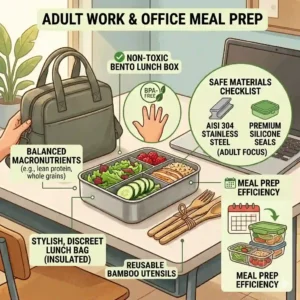
Problem to Solution: Beating the Leaky Bento Syndrome
One of the most frequent frustrations I hear from clients is that their expensive, eco-friendly lunch gear leaks immediately. Let’s solve the three most common pain points associated with a non toxic lunch box.
Problem 1: The “Capillary Action” Leak
You packed a perfectly sealed container, but a vinaigrette dressing seeped out the side.
Solution: This happens when thin liquids get trapped between the silicone gasket and the steel rim. The friction creates a capillary effect, drawing the liquid up and out. Never fill wet compartments past 75% capacity. For ultra-thin liquids, abandon the main container entirely and use a dedicated, screw-top stainless condiment dipper.
Problem 2: Temperature Loss in Metal
Your child complains their food is cold by noon, despite being packed warm.
Solution: Uninsulated stainless steel is highly conductive—it bleeds heat rapidly. You cannot rely on the container alone. You must pre-heat the container by filling it with boiling water for 5 minutes, dumping it, drying it, and then adding the hot food. Pair it with an insulated, foil-lined carrying bag to trap the radiant heat.
Problem 3: Warped Silicone Lids
The flexible lid on your U-Konserve Rectangular no longer sits flat.
Solution: You’ve been washing it on the bottom rack of the dishwasher, where the heating element is too intense. Silicone memory can be reset. Boil the lid in a pot of water for 10 minutes, pull it out with tongs, and immediately lay it perfectly flat on a granite countertop or cutting board with a heavy book on top while it cools.
How to Choose the Right Container for Your Commute
If you are staring at a screen trying to decide, use this simple decision framework to filter out the noise.
-
Assess Your Heat Requirements: Do you need to microwave your lunch? If yes, your journey ends here: you must buy borosilicate glass. Metal will spark, and while some silicone is microwave safe, it gets dangerously hot to the touch.
-
Evaluate the “Drop Risk”: Who is carrying this? If the user is under the age of 8, or if you work on a construction site, glass is disqualified. You must pivot to heavy-gauge stainless steel.
-
Audit Your Diet: Are you a “sandwich and chips” person, or a “curry and yogurt” person? Dry diets excel in unsealed metal (like the PlanetBox ROVER). Wet diets demand heavy silicone gaskets.
-
Calculate Cleaning Fatigue: Be honest with yourself. Will you realistically hand-wash a complex lid every single night? If you rely heavily on the dishwasher, avoid anything with tiny crevices or removable rubber O-rings. Opt for molded, single-piece lids.
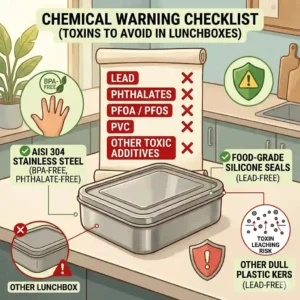
Common Mistakes When Buying Safe Lunch Gear
Most buyers focus entirely on the aesthetic of the container and ignore the engineering. This leads to frustrating mornings and wasted money.
The biggest mistake I see is overbuying capacity. People assume they need a massive 1200ml container, only to realize it doesn’t fit horizontally in their work bag. When a container is turned vertically, the internal dividers become useless—gravity takes over, and your sandwich gets crushed by your apple. Always measure the interior dimensions of your daily carry bag before purchasing.
The second mistake is falling for the “BPA-Free Plastic” trap. Many consumers think that as long as the plastic says BPA-free, it is a non toxic lunch box. In reality, manufacturers often swap BPA for BPS or BPF to maintain the plastic’s rigidity. These alternative bisphenols behave similarly in the human body. If you want true safety, you must eliminate rigid clear plastics entirely.
Finally, buyers ignore the replacement part ecosystem. A gasket will eventually fail. A latch might bend. If you buy a cheap, unbranded metal box from a discount site, you cannot buy replacement parts. Premium brands sell individual replacement gaskets for a few dollars, preventing the entire unit from ending up in a landfill.
Glass vs. Stainless Steel: A Detailed Comparison
When you eliminate plastic, you are left with a binary choice for the base material: glass or steel. Neither is perfect; both require compromises.
Borosilicate Glass (like the Bentgo Glass) offers unparalleled visibility. You can see exactly what is in the fridge without opening lids. It does not react to acidic foods—you can leave a lemon vinaigrette in a glass bowl for a week and it won’t pit or stain. However, the density of glass makes it aggressively heavy. Carrying three glass containers in a tote bag feels like hauling bricks.
Food-Grade Stainless Steel (304 or 316 grade) is the undisputed king of durability-to-weight ratio. It is remarkably light, making it the superior choice for children. However, it is entirely opaque, requiring you to label your meal prep. Furthermore, steel is highly thermally conductive. If you put hot pasta in a steel box, the outside of the box becomes instantly, painfully hot to the touch, requiring a secondary carrier.
Analysis: If your lunch stays in a refrigerator until lunchtime, go glass. If your lunch lives in a backpack, gets tossed in a locker, or goes on a hike, go steel.
What to Expect: Real-World Performance & Durability
The spec sheet says “dishwasher safe,” but the real-world performance is far more nuanced.
When you invest in premium stainless steel, expect it to look heavily scratched within the first month. This is called a “patina.” Keys, utensils, and countertops will leave micro-scratches on the surface of your LunchBots Large Trio. This does not affect the safety or toxicity of the box—stainless steel does not have a “coating” that can chip off. The metal is uniform all the way through.
Conversely, silicone components will inevitably change texture. Platinum silicone starts off delightfully grippy, but over time, exposure to dish detergents and food oils will give it a slightly slicker, matte finish. It may also undergo “bloom,” where white powder seems to appear on the surface. This is simply calcium from your water or natural silicates rising to the surface, and it wipes away easily with a damp cloth. Expect these visual changes; they are signs of a well-used, chemical-free tool, not a defective product.
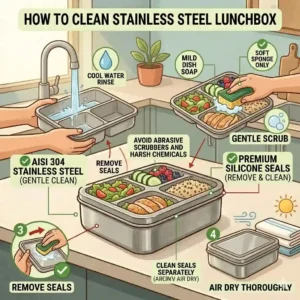
Container Solutions for Specific Audiences
Different demographics interact with food storage in drastically different ways.
For Seniors & Individuals with Arthritis:
The anti-recommendation here is anything with snap-hinges or tight silicone seals. The vacuum lock created by a cold fridge makes pulling off a tight silicone lid physically painful for arthritic hands. Instead, look for heavy glass containers with oversized, lever-action latches, or unsealed metal tins where the lid simply rests on top with minimal friction.
For Bodybuilders & High-Volume Eaters:
Most bento boxes are designed for 600-800 calorie meals. If you are packing a 1,200 calorie macro-dense lunch, a traditional bento will frustrate you. You need to abandon the multi-compartment design entirely. Look for single-cavity, deep-dish stainless steel roasters with a silicone band. You need volume, not compartmentalization.
For Sensory-Sensitive Children:
Kids with ARFID (Avoidant/Restrictive Food Intake Disorder) often cannot tolerate their foods touching, or even the smell of one food crossing over to another. A loose metal box will fail them. You must utilize a heavily gasketed system like the Yumbox Presto, where the silicone literally stamps down a barrier wall between the strawberries and the crackers.
Hidden Cost Analysis: Plastic vs. Premium Materials
Let’s talk about Total Cost of Ownership (TCO). A plastic, multi-pack bento set costs $15 for a pack of four. A single PlanetBox ROVER costs around $60. The math seems obvious, but it’s deceptive.
Rigid plastic relies on plasticizers to maintain its shape. Every time you run it through the high heat of a dishwasher, those plasticizers leach out. Within 6 to 8 months, the plastic becomes brittle, cloudy, and prone to cracking at the hinges. Furthermore, the porous nature of degraded plastic harbors biofilm (bacteria) that causes permanent odors. You will replace that $15 set at least once a year.
Over a 5-year elementary school career, you will spend $75 on cheap plastic that actively degrades into your child’s food. The $60 steel container will still be fully functional on middle school graduation day. The true hidden cost of plastic isn’t just the replacement frequency; it’s the invisible biological cost of microplastic ingestion, which the EPA continues to monitor as a growing public health concern.
Safety & Regulations: Decoding PFAS and Lead-Free Claims
The regulatory landscape for a non toxic lunch box changed dramatically leading up to 2026. If you are reading labels, you need to understand what the certifications actually mean.
“Lead-Free” vs. “Lead-Safe”
Several high-profile scandals over the last few years revealed that popular insulated water bottles and food jars used a lead solder pellet to seal the vacuum insulation at the base. While the lead didn’t touch the food, a dented base could expose the user to lead dust. Look for brands that explicitly state they use a “lead-free glass frit” or a completely welded vacuum seal.
The PFAS Ban
PFAS (forever chemicals) were commonly used in the non-stick coatings of cheap metal lunch boxes to make them easier to clean. Under new consumer protection guidelines, reputable brands have abandoned these coatings. If a metal box claims to be “non-stick,” run away. Raw stainless steel should be somewhat sticky to food—that is proof it lacks chemical coatings.
Always check for CPSC (Consumer Product Safety Commission) compliance certificates on children’s products. Reputable companies will post their third-party heavy metal testing results directly on their websites. If they hide the data, hide your wallet.
✨ Don’t Miss These Exclusive Deals!
🔍 Ready to make the switch to a healthier meal prep routine? Click on any of the highlighted products in this guide to check current pricing and secure your non toxic lunch gear today!
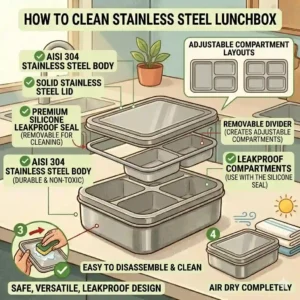
Conclusion: Investing in Your Daily Health
Transitioning to a completely non toxic lunch box is one of the highest-leverage health decisions you can make. You interact with your food storage every single day. By eliminating plastics, you are cutting off a major source of daily chemical exposure at the root.
Whether you opt for the indestructible nature of the PlanetBox ROVER, the leakproof convenience of the Yumbox Presto, or the microwave-ready elegance of the Bentgo Glass, the key is matching the material science to your daily routine. Don’t buy based on aesthetics; buy based on your commute, your dishwashing habits, and your specific dietary needs.
Taking the time to maintain your stainless steel and silicone gear will ensure it outlasts any plastic alternative on the market. Pack smart, eat safe, and enjoy the peace of mind that comes with knowing exactly what is—and isn’t—getting into your food.
FAQs
❓ What materials make the best non toxic lunch box?
✅ The safest materials are 304 or 316-grade stainless steel, borosilicate glass, and platinum-cured silicone. These materials are chemically inert, meaning they do not leach microplastics, bisphenols (like BPA/BPS), or phthalates into your food, even when exposed to high heat…
❓ Can you put a stainless steel bento box in the microwave?
✅ No. Stainless steel reflects microwaves, which can cause arcing (sparks) and damage your appliance. If you need to reheat your meals at work or school, you must choose a borosilicate glass container instead of a metal one…
❓ Do silicone lunch box seals retain food odors?
✅ Yes, silicone can absorb volatile organic compounds from strong-smelling foods like garlic or onions. To remove the odor, bake the dry silicone lid in an oven at 250°F (120°C) for 20 minutes to off-gas the trapped scents safely…
❓ Is a non toxic lunch box completely leakproof?
✅ It depends on the lid. Pure metal-on-metal designs are not leakproof and will spill liquids. To achieve a leakproof seal, the container must utilize a food-grade silicone gasket or a fully molded silicone lid pressed against the compartments…
❓ How do you prevent rust spots on a stainless steel lunch box?
✅ High-quality 304 stainless steel resists rust, but hard water or salt can cause pitting. Avoid leaving wet food in the box for days, dry it thoroughly after washing, and remove calcium spots with a quick vinegar and warm water soak…
Recommended for You
- 5 Best Silicone Bento Box Picks for 2026: Expert Tested
- 5 Best lunch pail ice packs (2026): A Food Safety Expert’s Honest Reviews
- 5 Best lunch lock box Models to Stop Office Food Theft in 2026
Disclaimer: This article contains affiliate links. As an Amazon Associate, I earn from qualifying purchases. If you purchase products through these links, we may earn a small commission at no additional cost to you.
✨ Found this helpful? Share it with your friends! 💬🤗
